Showing posts with label dessert. Show all posts

Saturday, 28 November 2009

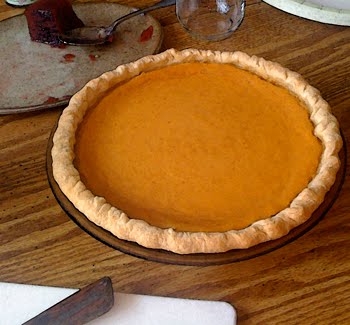
What kind of pie?


Corn on the cob and sweet potatoes—two foods that most European-types I know don't love (my spouse is an exception). My father-in-law calls both "pig fodder," but then again he will eat polenta no prob, but then again he is from Milan so I guess eating swine chow is okay if it's dried and milled. I'm also pretty sure that it's dried corn that they pump through the feeding tubes (calorie-bongs?) used in fattening waterfowl livers for foie gras, and so the French are consumers of lots of corn as well, if somewhat less directly than the Milanese. But fresh sweet corn is a wonderful thing, and if the Europeans aren't eating it, then fine—there's more for us. This is exactly what Karen said when I told her that a post on sweet potato pie would not be of much interest to her yankee-expat followers who are cooking for European spouses and their families.

As far as flavor is concerned, I don't think it really matters which variety of sweet potato gets used, but the kind that is bright orange is the classic. A sweet potato pie made from a white- or yellow- flesh variety would look pretty non-traditional. Since these potatoes come in some pretty irregular shapes (usually very thick in the middle, tapering to narrow ends), I start by cutting them into uniform sized pieces that will cook in the same amount of time. I drop them into boiling, salted water and simmer them until they're done—about 15 minutes, depending on how big the pieces are. Then I drain them in a colander, and while they're hot, I remove the skins and run them through a potato ricer. This will leave a small amount of fiber-y stuff in the mash, which I prefer to eliminate by running it through a food mill (this can be done after the mash has cooled).

A classic American pie crust is your basic short crust with the difference that the butter is not quite fully incorporated into the flour. The tiny chunks of butter flatten out between the flattened bits of dough, and this is what makes a flaky (rather than crumbly) crust. I make mine with about two sticks of cold butter (roughly 400 grams, salted of course) which I cut into a good measure of flour (three cups? Sounds about right.) with a pastry knife (which is really a sort of round-bottom potato masher) until the butter is almost but not quite fully blended with the flour. Then I mix in some really cold water (about a quarter-cup) with a wooden spoon just until the moisture is uniformly distributed and the dough actually resembles a dough. Then I wrap the dough in plastic and throw it in the fridge for a couple of hours. Then I roll out a huge circle of dough—there's much more than what's needed for one pie, so I cut off all but a generous inch of overhang after putting it in the pie tin. The rest can go back in the fridge for some other creation. The overhang gets rolled and crimped and I prick the bottom a few times with a fork. Then this gets covered with plastic again and thrown in the fridge. I know that this sounds pretty complicated and pie crusts can be pretty intimidating at first, but you just have to make it a few times and then it's not such a big deal.

My pie filling is a can of sweetened condensed milk (I think the standard size in the U.S. is about 7 or 8 ounces), three eggs, a bit of ground ginger (the dried stuff, not the fresh stuff), a bit of nutmeg, and about two cups of the cooled sweet potato mash. After homogenizing all this you'll need to add sugar—how much is needed will depend on how sweet the potatoes were (and there's quite a lot of variation in sugar content) and how sweet you like your pie. I like using superfine (baker's) sugar for this, but I suppose regular granulated would work, too. Need a rough estimate for starters? Maybe about half a cup. I typically add a bit more sugar than what tastes right when I'm making the filling, since I find that the final product usually ends up not sweet enough when I add sugar just to taste.

The filling should now be thick but pourable. Remove the crust from the fridge, fill and bake at 350°F (175°C) for about 45 minutes to an hour until the crust is golden and the filling is puffing up but not quite browning. If you have extra filling, I suggest filling a couple of ramekins and baking them along with the pie—this makes a nice pudding—but the cooking time may be a little different from the pie.

This is a pie that should be thoroughly cooled before serving (otherwise the spices you added may be overpowering), so making this pie the day before the big dinner is both wise and gets one more dessert out of the way.

Thursday, 26 November 2009

Cream puffs

Those of you who grew up with me (yes, that includes grad school friends, let's face it) will probably remember the killer cream puffs. So here's the recipe (happy now, you who shall remain nameless????!!!!):

1 stick of butter (real butter, no substitutes!)
1 cup water
1 cup flour
Pinch of salt
4 eggs

Tips:
1. It's essential to use precise measurements & follow directions scrupulously or these will be cement puffs
2. DO NOT OPEN THE OVEN THE 1ST 20 MINUTES OR THE PASTRY WILL NOT PUFF

Preheat oven to a high-medium heat.
Melt butter in water. DO NOT BOIL.
Take pot off heat, add the flour with salt ALL AT ONCE. With wooden spoon quickly mix & form into a ball.
Let mixture cool 10 minutes.
Beat in eggs ONE AT A TIME.
Spoon onto a cookie sheet, leaving an inch between.
Place in oven. DO NOT OPEN DOOR!
After 20 minutes, turn heat down to medium.
When pastry is golden remove from oven and place puffs on a cooling rack.
If hermetically sealed, the puffs will keep up to 5 days.

Fillings: whipped cream, custard, ice cream.....
Glaze: sugar, caramel, chocolate.....

Monday, 1 June 2009

Two (French) Tarts

If Sophie has a defect - apart from being French, which she was kind of born with and it's not really her fault so stop laughing at her - it's that she doesn't really appreciate dessert. Apart from pavlova, for some strange reason. I mean, you can make a 12" pav, set it down in front of her and by the time you've turned back around with the cake-slice to serve her, half of it's gone. Let's be honest, it's not just her - although she is an extreme case - most frog-persons we know would die for the stuff. Or at least commit unspeakable acts. What is it about soggy meringue, whipped cream and fruit that will lead people to sell their children on the wharves at Marseilles?

I don't know, because I don't actually like the stuff that much, which is doubtless one reason why our kids are still running around free rather than having one leg chained to a wall and serving tea in a low-life souk somewhere in Morocco.

Whatever, following are two recipes which I've never ever made for Sophie and probably never will. Now were I to offer her chicken in cream sauce with morilles and vin jaune ... we'd be selling her kids in Marseilles. (To get the cash to buy the morilles and vin jaune, obviously.)

For both the recipes which follow, you will need some sweet short pastry. You can either make it, or buy it. I've a confession to make: if it's flaky pastry I tend to buy it, unless it's for the galette des rois, when I will suffer and make it myself. I buy it partly because I'm not actually a chef patissier and consequently don't feel obliged to make it, but mostly because it's a pain in the arse to make. Properly, anyway.

But anything else is a doddle. You may well have your favourite recipe, in which case feel free to use it: I use (for one tart) about a cup of flour, 50 gm or so of butter, a few tablespoons of sugar, ditto powdered almonds, milk to mix and, on occasion, a tablespoon of orange-flower water. If you're planning on making both, you'll obviously need double the quantity.

There are several schools of thought concerning the butter. One holds that you should use nothing but unsalted. Right, that's them consigned to the 7th pit of hell, freezing in Satan's icy blasts and hopefully wondering where they went wrong. Another believes that you should chop the butter into the flour until you've got a mixture like breadcrumbs - they're merely misguided, and I wish them no harm. Personally, I like to mix the dry ingredients together with a fork, add the butter in 0.5cm chunks, stir in the liquid until it just holds together and then fold and knead it very lightly. Like this you get what is technically known as bastard puff pastry, which I like. It's semi-flaky, and very buttery. There should be big smears of butter in it when you roll it out. (Incidentally, the same principle - less the almonds, sugar and orange-flower water, obviously - and using an egg instead of/as well as the milk - works really well for quiches. If anyone still eats them, these days. They go really well with a salad.)

The next thing to worry about is whether or not to bake blind. Most books will tell you that having rolled out yer pastry and lined the dish, you should stick a round of baking paper on top and fill it with either dried beans or hideously expensive ceramic replicas and bake for 15 minutes, the idea being to stop it puffing up and making unsightly blisters.

For one thing, this depends on the filling you're going to put in. For some - like the peach tart below, yes, you do want to bake blind - otherwise you'll get prematurely soggy pastry, which sounds rather like some sexual dysfunction but isn't. For others, like the redcurrant meringue or a tarte frangipane aux cerises (which I may tell you about another time), you do not.

Whatever, if you are baking blind, I personally can't be arsed with the baking paper and the beans: stick the lined pie-dish in the oven for 10 minutes, pierce any large bubbles with a knife so that they deflate, then take out your pastry brush and paint the base with lightly-beaten (ie well-whipped with a fork) egg-white and stick it back in for another 5 minutes. This will a) seal the holes from the knifepoint and b) seal the pastry so that it doesn't start to dissolve with the fruit juices from the filling.

Right, on with the fun. First up is - tada!

Peaches and cream tart.

I have to admit that I lifted this one from an Australian author, Stephanie Alexander. I find her style condescending, but the recipes are good.

Beat hell out of three egg yolks, 1/2 cup castor sugar, a few drops of vanilla essence, a tablespoon or two of cornflour and 3/4 cup of sour cream. Feel free to add more flour or cornflour if you're worried that the mixture looks too sloppy. But hey - we're making a soufflé here. Then - the bit she forgot - beat the egg whites until very stiff and gently fold them in. Spread some of the mixture on the base of the tart and cover with thinly quartered peaches, or nectarines, or both. Spread the rest of the mixture over the top, smooth, and sprinkle with brown sugar. (Use a sieve for this. Otherwise it will not so much sprinkle as descend in huge lumps.) Bake until set (about 25 minutes), serve, pig out. Like I said, bake blind for this one.

Tarte meringuée aux Groseilles (aka redcurrant meringue tart).

This one comes from the clippings folder - can never find it when I want it, but luckily enough it's sort of got built-in now, like the recipe for clafouti and homard palestine. You will need about 300 gm of redcurrants for this one, so if you haven't got them adapt. Use frozen raspberries, for example. Do I have to tell you everything?

Whatever, beat two egg yolks up with sugar and 100gm or so of powdered almonds until white and creamy. Put them aside while you whisk up the egg whites with some more sugar until firm. Fold half the egg whites into the yolk mixture along with half the redcurrants, spread into the lined pie dish. Now fold the rest of the redcurrants into the remaining meringue and spread over the tart. You could probably sprinkle that with sugar too. Cook, eat. Yum.

Postscript

You may have noticed that I've not explicitly noted points during the preparation of these two at which you may reasonably take a drink. Sorry for the oversight, it will not happen again. On the other hand, assuming they're both in the oven, you've got a good half hour before you need to worry about them, so feel free.

Saturday, 2 May 2009

Chocolate chip cookies

Another request from France, where chocolate cookies are a phenomenon & sold in fancy bakeries, although they are nowhere near as good as in the US. French friends ask me to bring them as dessert when they invite us to a dinner party as if they were a delicacy! The kids also bug me daily to make them... This recipe comes from way back when I was a kid & is still the best.
For my kid's birthday parties I put the whole batch of batter onto a pan and make Chocolate Chip Cookie Cake. Decorate with sprinkles, M&Ms, whatever!

TIPS: DON'T OVERCOOK!
If kids don't like chunky pieces of nuts, then add ground walnuts, almonds, pecans.....
A little grated coconut goes a long way flavorwise!
I only use really good dark chocolate, smashed into chunks.

CHOCOLATE CHIP COOKIES
1 cup whole wheat flour
1 1/4 cup white flour (or 1 cup flour, 1/4 cup ground nuts + grated coconut)
1 tsp baking soda
3/4 cup brown sugar
3/4 cup white sugar
1 tsp vanilla
2 eggs
1 cup or 2 sticks butter (room temperature)
1 pack of chocolate chips or 12 oz chopped chocolate

Preheat oven 375°.
Combine butter, sugar, vanilla until creamy.
Beat in eggs, singly.
Gradually add dry ingredients.
Add chocolate or other fun sweets.
Drop onto a cookie sheet with a tablespoon, don't flatten & space apart.
Cook until edges are golden but center is still soft, about 8 minutes.
Remove from oven, let cool a few minutes before transferring to a cooling rack ( or plate).
If the kids don't scald themselves devouring the oven hot cookies, let them cool completely before placing in a tight lidded tin.
Theoretically they keep 5 days, or can be frozen, but normally the shelf life of cookies is maximum the next day (triple recipe, hidden tins)

Thursday, 30 April 2009

DUTCH BABY, but please, no Heineken

Last summer I had a free day in Munich. Saw some sights, walked miles through cold, wet, rainy streets in a tee-shirt and flipflops, and around dinnertime I pulled into a bratwurst Kneipe (public house)—I think it was actually called "Das Bratwurstkneipe"—for …

… surprise! Not bratwurst! I was after Kaiserschmarrn, a kind of heavy, fruity, caramel-y pancake recommended to me by a friend. This kneipe was right off the Viktuellenmarkt (food-focused marketplace) and though it was only late afternoon, the place was packed with locals eating and drinking. I found a spot at a communal table across from a "more mature gentleman," and it's not that I'm concerned about the fellow's age so much as the fact that I needed to rely on my rather rusty German to communicate with him. Pretty much any German under 40 will speak at least a little English these days, but this guy was well outside that demographic.

I thought my early-dinner request for a sweet dish might seem a little weird, but the waitress didn't flinch. It was an interesting meal with labored, cross-cultural, cross-generational conversation, lots of beer, and one gigantic plate of raisin-y, crusty and maybe a bit overly-sweet pancake that comes with its own side of prunes—to help clear the path for the next meal, no doubt. These Bavarians like to eat.

So my companion finishes before me, and as he's about ready to leave he confides that he was highly disturbed by the fact that I drank beer with my supper—one should always drink red wine with Kaiserschmarrn. What!? Germans drink beer all day long and with every meal besides breakfast, but have a brewski with your Kaiserschmarrn and the locals get offended!

But here's the thing. I didn't like the Kaiserschmarrn nearly as much as similar things I'd had before—and the obvious candidate for a lighter, less-sweet alternative is the Dutch Baby. Quick and easy to make, it's also another great opportunity for me to use my big cast-iron skillet.

Okay, so I start by pre-heating the oven and the skillet to 425°F. Four eggs, ¾ cup of whole milk, ¾ cup of all-purpose flour, half a teaspoon of salt, a dash of vanilla (and maybe some nutmeg if you're into that kind of thing), get beaten to a frothy milkshake—what I'm trying to say is, "Don't worry about overmixing."

Oh yeah, these quantities work for me when I'm using a Number 12 skillet, which is kind of a king-sized model—if you're using a smaller (or bigger) unit you'll need to adjust quantities accordingly. Just remember that the volume needed is proportional to the square of the diameter of a round pan. Heh heh.

Anyways, half a stick of butter (cut into small pieces) hits the hot skillet and melts in a flash and start to brown as I swirl it to coat the bottom and part way up the sides of the pan. The batter goes into the skillet, which then goes back into the oven.

The topping for a Dutch Baby is just sugar and lemon. I take about three tablespoons of superfine sugar and mix in the zest that I have microplaned from a small lemon. Some of that lemon's juice will be squeezed on as well.

Inside the oven there's some kind of Gauss-Markov process that directs a completely unpredictable pattern of puffing and browning, and it's done when it looks like the pan is occupied by a hideously deformed, roasted, northern European baby.


Within seconds of its "birth" the baby deflates substantially, at which time I sprinkle on the lemon sugar and squeeze on about half a lemon's worth of juice. Is it breakfast? Is it dessert? These are questions I can't answer. One should be advised, however, that if there's a German anywhere nearby (maybe a Dutch, too), hide the beer.

Monday, 16 March 2009

Gâteau au chocolat fondant-oozing chocolate cake

Melts in your mouth & your plate! Chocolate cake is a birthday favorite, so try this recipe out! The cake must be "undercooked", as the whole point is that when cut the center oozes chocolate all over. We like this with whipped cream or à la mode.
TIP: use good quality dark chocolate, not chocolate chips. Zap in microwave with butter to melt it.

8 0z dark chocolate
5 tbsps flour
6 oz sugar
6 oz butter
4 eggs

Preheat oven to 400°F.
Grease & flour a spring form pan.
Melt chocolate with butter.
Seperate yolks from whites.
Add yolks to chocolate mixture while whisking. Whisk in flour & set aside.
Beat egg whites until stiff, gradually adding sugar.
Fold egg whites into chocolate mixture.
Pour into pan & bake about 30 minutes. Check that the center is not too cooked, it should be solid on the edges but not the center.
Serve right away or just warm.

Cheesecake


Classic cheesecake, let the basic recipe inspire you! Usually I serve this with a fruit topping. Sometimes I add chocolate chips, caramel swirls.... inside or on top! When I have it, I also add some aromatic liquor like the French poire or Italian Marsala (about 2 tbsps).


TIP: Make this cake the day before!

Crust
1 cup graham crackers
1/2 tsp cinnamon
3 tbsps brown sugar
5 tbsps melted butter or margarine

Filling
Rind 2 lemons
24 oz cream cheese
1 cup sugar
1/4 tsp salt
1/2 tsp vanilla
5 egg

Topping
1 1/2 cups sour cream
2 tbsps sugar
1/2 tbsps vanilla

Preheat oven to 350°.
Grease bottom & sides of a spring form pan and/or line with wax paper.
Mix together ingredients for crust. Pat in crumbs on bottom & sides of pan.
For filling, mix cream cheese & grated lemon rinds into a large bowl.
Beat until creamy.
Add sugar, eggs & salt.
Beat until smooth.
Pour into pan.
Bake until set, about 45 min.
Remove from oven to let cool 10 minutes.
Prepare topping by beating ingredients until dissolved.
Spread onto cooled cake.
Return to oven 10 minutes.
Remove & let cool, then refrigerate at least several hours before serving.

Before serving, decorate with chocolate shavings or fruit topping.

Wednesday, 4 March 2009

HAMANTASCHEN-OZNEI HAMAN-Purim cookies

Purim is a Jewish holiday also known as the Feast of Esther. Jewish holidays follow a lunar calendar, so it usually falls in late February or early March (like this year: 2009 or 5769 by the Jewish calendar). Hamantaschen or the "pockets of Hamam" are one of the traditional treats made for Purim. These cookies are simple & can be made with any number of fillings (including any jam you like). In a hermetically sealed container they keep 5 days (if the kids don't eat them all) & can be frozen.

The basic recipe that follows is the one I've always made with my kids because it's very simple. This can be made in a food processor (metal blade) or by hand.

TIP: Any kind of butter pastry should be as lighltly kneaded as possible or it will harden.
Dough must always be refrigerated. This pastry dough requires at least 3 hours, so I often make it a few days ahead of time.

Pastry:
1 egg plus 1 yolk
4 cups flour
1 1/2 cups sugar
2 tsps baking powder
2 sticks of butter plus 4 tbsps
lemon zest

Beat egg & yolk. Set aside
Put dry goods in processor or large bowl.
Cut butter into small cubes & sprinkle over dry mixture. Either process or mix with a fork until the texture is crumbly.
Add beaten egg.
Blend until dough starts to form a ball. If still too dry, add a little lemon juice or water by the tsp.
Add zest.
Blend or knead into a ball.
Remove from bowl & flatten into a disc.
Wrap in plastic. Refrigerate.

Grease cookie sheet.
Roll dough out as lightly & thinly as possible.
Use a round cookie cutter or wine glass to cut out circles.
Put a heaping tsp of filling in the center.
Wet edges with water then pinch them towards the center to form a triangle.
Place on cookie sheet & refrigerate 1 hour.

Preheat oven to a medium-hot temperature.
Bake about 10 minutes or until golden.


Prune or dried fig Filling:
Blend the following ingredients in food processor or by hand.

1 cup pitted prunes or dried figs
1/2 cup raisins
4 tbsps walnuts (or other nuts)
4 tbsps jam (I prefer orange marmelade)

Thursday, 26 February 2009

Chocolate mousse by Delia

Here's my recipe for chocolate mousse & it's not only delicious but Easy, Peasy. Who has time to make complicated desserts anymore?

8 ounces bittersweet chocolate (the really good kind like Belgian or swiss chocolate--do not use chocolate chips!!)
4 eggs, separated
2 tbsp. sugar (optional)
1 vanilla bean or 1 tsp. vanilla
brandy and/or fresh squeezed oranges & chopped zest for flavor

melt chocolate in microwave until soft. when chocolate is a little cooled add egg yolks (not whites) stirring constantly.
add sugar to taste (optional--I don't add any).
you can also add the liquor and/or orange juice but be sure not to make mixture too watery.
I like to add as well the zest of one or two oranges (chopped very finely) to really bring out the orange flavour.
In a separate bowl beat the room temperature egg whites to a stiff peak (I use 4 extra large eggs, or 5 large eggs, or six small eggs). you can also add a pinch of salt to make the egg whites stiffer.
slowly & gently fold the chocolate mixture into the stiff egg whites in batches. make sure the mixture isn't watery--if it is quickly beat another egg white & fold it in to make the mixture thicker. taste it & add more vanilla, liquor, sugar, zest, etc. as needed.
place in fridge until mousse sets (several hrs.)
serves about 4 non-greedy people.
i usually double the recipe by adding just a bit more chocolate & double the egg whites.
this recipe is quite flexible & forgiving if you keep keep the liquids to a minimum, but be sure your chocolate is of high quality as you can really taste the difference.
also pasteurized eggs from a reputable brand should be used to avoid nasty salmonella.