Although my kids were raised here in France, Thanksgiving is a tradition in our family (celebrated the following Sunday, as obviously it is not a holiday here). Here the turkey has to be ordered ahead of time from the butcher or producer, which means it's really fresh and PC. Usually we celebrate with another expat family, which means I share the cooking, but this year it's just us (8-10, not counting the dogs).
So the following is my traditional menu:
-Turkey
-Chestnut stuffing
-Cranberry sauce with orange
-Oven baked yams
-Pumpkin pie
Side dishes depend on whatever fresh produce is available.
Turkey
The day before I rub garlic-herb butter under the skin of the turkey, then put it covered in the fridge. Just chop up fresh herbs (sage, rosemary, thyme, tarragon, etc) and blend into room temperature salted butter, along with about 4 crushed cloves of garlic.
Take the turkey out of the fridge about an hour before cooking. Add stuffing.
Preheat oven to high. Calculate cooking time to 20 minutes/lb + 20 min
Massage salt & pepper into the skin of the turkey. Splash some olive oil or melted butter with white wine on it & place in oven.
Baste the turkey with its juices about every 20 minutes. Add more wine as necessary.
After about 30-40 minutes (depending on the size of the turkey), turn the heat down to medium.
Continue basting! If the turkey seems to dry, cover with foil until the last 30-40 minutes.
For browning, turn the oven back on high for the last 10-20 minutes. Then turn off heat & let sit 5-10 minutes before serving.
Chestnut stuffing
For the stuffing I toast dried bread as if making croutons. Just cut it in chunks and grill. I chop the chestnuts into large chunks as well. Modify according to taste!
Tip: the stuffing can be made ahead of time. In which case, add the egg just before inserting into the turkey.
1 lb cooked chestnuts or chestnut purée
1 large onion
1/2 loaf of dried bread or 2 cups bread crumbs
2 celery stalks, chopped
parsely
1 egg for binding
(livers & other meats may be added to the recipe)
In a large saucepan sautée onion and celery. Add chestnuts & splash of wine. Add parsely & season according to taste. Add bread. Turn off heat and let cool.
Add beaten egg, then proceed to stuff the turkey.
Thursday, 26 November 2009

Wednesday, 25 November 2009
If it quacks like a duck ...
Today I am not a happy camper. I have spent two hours on the phone trying to get France Telecom to send the bills for the home phone/internet to the office, and getting the actual billing account details changed to the business account. As was supposed to have been done when I took the contracts out, back in June.
This means I have spent two hours variously on hold, being shuttled between the "professional" and "particuliers" services (because apparently a professional account cannot be tied to a domestic phone, godnose how I managed to get the contracts set up but it didn't seem to worry them at the time), being cut off just as I'm to be transferred to someone who might be able to help ...
I would really like to kill someone. Preferably rather slowly, and it would probably involve roasting in my huge oven and perhaps some of the less-used kitchen implements around here. (I'm thinking maybe the butter curler, and perhaps the peculiar Device for removing the strings from celery stalks.) Best, perhaps, not to dream, and just say WTF. Which, as David Lebovitz pointed out, does not mean what you think. It's just the acronym for "Welcome To France", which just about says it all.
Anyway, I annoyed Sophie a week back by turning up at midday on Saturday and getting a perfect roast chicken ready. Well, annoyed is perhaps not the word (in fact, fâchée is, at least in Frog), more gênée, or embarassed. OK, she was in fact fâchée because she'd told me not to do anything (in my defense, let it be said that it was more of a recommendation than an outright order), and gênée because she worries what people might think - a semi-divorced woman being catered for by a married man! Shock, horror. I did point out that, if ever pressed on the matter, she could claim that the food was crap and therefore didn't count - not entirely successful as arguments go, but as she polished off the second drumstick we agreed to speak no more of the matter.
And in future, I will not turn up with unannounced food. Not even a chicken, which requires sod-all in the way of preparation and attention to become an object of desire. Just rubbing a decent spice mix onto the flesh under the skin and then into the oven for an hour or so ... bliss. Add some roast potatoes and a good salad and I'm yours. Especially if there's a Côtes de Languedoc to go with it.
Be that as it may, she did say that she wouldn't mind trying a bit of duck one day. Which is a rather treacherous admission coming from a Bressane (that would be someone from the Bresse region) where the chicken is king. Along with cream. One of these days, I'll get Sophie to give me her grandmother's recipe for poulet de Bresse à la crême and just maybe I'll share it.
Whatever, maybe I've corrupted her but she's getting these urges for red meat, and duck's a good way to get into that. And one of the best ways to have duck would have to be cuisses de canard confites, aka ducks legs cooked in their own fat until they fall apart.
One of the best recipes I've ever come across for this sort of thing comes from Charcuterie, by Michael Ruhlman. I'm not going to give it to you because I actually bought a copy with my very own money and you can damn well go and do the same, but I will tell you that it involves a brief salting with orange peel, cinnamon and star anise before the actual act of confiture ... I can see you dribble, you know.
On the down-side you do need to start it about three days in advance, which is not always an option. But a simple confit takes only a couple of hours (OK, maybe three) and is quite excellent.
Basically, all you need is some ducks legs. And a bottle of wine, or maybe two. A Côtes du Rhône, or a decent something from the Gers. Some potatoes and a few leeks would be good too.
First of all, put a good solid frying pan on the heat and open the first bottle of wine. None needs to be reserved for the actual cooking, so serve yourself liberally. When the pan's good and hot, turn the heat down and fling in the duck legs, skin side down. They will probably spit: so would you, under the circumstances. Give them half an hour or so like that: at the end of this time the skin should be crispy-brown and there'll be about a half-inch of duck fat in the pan. So turn the heat down as low as it goes and turn the legs over.
After another half-hour (during which I hope you've been paying attention to the wine) the meat will be well-cooked but will not as yet have achieved confit. So turn it over again, put a lid on top (or tinfoil, if you've no lid), and leave it for an hour. During which you could definitely drink, discuss whatever comes to mind, or maybe get a dessert ready. Up to you.
After an hour's steaming whilst simultaneously bathing in grease, the ducks legs are getting ready. Now would be a good time to peel a couple of potatoes and cut them into cubes, and slice a few leeks into half-inch slices. (The leeks are optional, use onions if you prefer.)
Now remove the legs from their fat and add the potato cubes in their place: raise the heat a bit and stir them around, covering them with fat, for ten minutes or so. Then add the leeks and carry on stirring for another five minutes. You will notice that the fat is magically disappearing: an as-yet unexplained mystery. There will be no cholesterol in the finished dish.
Sprinkle with salt and some herbes de Provence, then put the legs back in, skin-side down again, and cover once more. After 15 minutes the potatoes should be well and truly done: remove the lid, turn the heat up high to crisp the duck skin (this will take a couple of minutes) and serve.
Personally I would not go overboard on the side dishes. In the Gers you might find this accompanied with white beans cooked with tomatoes (getting perilously close to cassoulet) and the whole lot may well be preceded by foie gras: I would not turn down the foie gras but I'd settle for a salad with the duck. And there's that second bottle of wine, of course.
Oh, I finally did get the phone billing sorted out. Until the next time. I just had to pretend not to know anything about the business number (because otherwise I'd've been transferred to the commercial service, which doesn't want to know about domestic numbers) and sob. A lot. At the end, that was quite easy.
Tuesday, 10 November 2009
The nights are drawing in, you can see your breath in the mornings, the air smells of woodsmoke. I’m wearing pyjamas to bed. The fruit bowl is laden with clementines. In short, the time of salad and quasi-vegetarianism is well and truly over. It is time to eat meat.
It’s also, in these recessionary times, time to find creative ways to make the more costly ingredients go further. With this in mind, I decide to make a big batch of white beans. When I find them I splurge on the extraordinary ‘haricots de Tarbais’, a type of bean so truly delicious that it is ‘appellation contrôlée’, in other words, awarded a certificate of authenticity. Only then can they be labelled with the magic word ‘Tarbais’, after the area where they are grown, Tarbes, in the Hautes Pyrenées in south western France near the Spanish border. Tarbais beans have an exceptionally thin skin and a particularly luscious texture; apparently they can only be harvested by hand, which explains why the last kilo bag I bought set me back €15.
Feeling unusually flush, I tried to buy some more the other day from my nearest gourmet épicerie, but apparently there’s a current shortage, and so I am forced to use a dusty bag of beans that’s been in the cupboard quite some time, and comes, I would guess from the Arabic writing on the label, from North Africa. Still, properly prepared these unpromising-looking dingy little pebbles prove perfectly tasty.
Pour a cup of dried white beans into a pan, cover with water by about an inch. Pop a whole carrot, cut into chunks, a peeled and halved onion and a couple of bay leaves in and bring to the boil. If you remember you can skim off the foam at this point, but honestly, I don’t think it makes any difference. Turn down to the lowest possible simmer and cook, covered, until the beans are tender, which might take 45 minutes and might take 2 ½ hours. Check that the beans are covered by water and top up occasionally as necessary.
When the beans are totally tender – make sure they have gone past the chalky point – salt the water generously and add a big glug of olive oil. To check that they are salted to your liking, taste the water, rather than a bean, since the beans themselves take time to absorb the salt.
You can and probably should leave them for a couple of days; the longer you leave them the more flavoursome they become and the liquid they were cooked in becomes delightfully silky. But that requires some forward thinking, which I don’t really go in for, so of course I use them the very night they are prepared, for a lovely end of autumn fish stew, a version of a recipe from the Zuni Café cookbook.
Cut a fennel bulb into eight wedges and brown on all sides in some olive oil. When they are beginning to caramelise at the edges, add a couple of chopped white onions and a few chopped garlic cloves and gently sauté, but don’t let the garlic brown. Add a chopped dried chilli and a slug of ouzo or pastis, raise the heat briefly to boil the alcohol off, then tip in a can of tomatoes and a glass of white wine. Taste for seasoning, then tip in a cup of cooked white beans. When you’re ready to eat, simply tip the tomato and bean stew into a casserole dish that can go on the stovetop, nestle four pieces of fish (cod, halibut, monkfish, anything with nice big chunks that won’t fall apart as it cooks) inside and poach until the fish is done. This is incredibly delicious with aioli, homemade or at a pinch a scoop of Hellman’s with a couple of crushed up cloves of garlic stirred in.
Now you’ll find yourself with quite a lot of beans left over. Of course you could just toss them with a chopped shallot and some vinaigrette and even a can of tuna, but your family will love you more if you make use of the leftover confit de canard from dinner last week. (I just open a large tin, scoop out the pieces and stick them in the oven at maximum temperature until the skin crisps up so that you need a hammer to break it, but if you’re Karen you make it from scratch – I’ll leave her to tell you how.) Because if you have some leftover confit, some perfectly cooked haricots de Tarbais or de anywhere else, an onion, some sausages and some leftover bread - you have the makings of what’s known in our house as a Cheat’s Cassoulet. Do not dismiss it until you’ve tried it. It’s really very good indeed.
Preheat the oven to 175 degrees. Chop a couple of onions, a carrot and three cloves of garlic and soften in a little olive oil. Add some chopped bacon, raise the heat a little, and fry till the bacon crisps. Throw in a can of chopped tomatoes, a cup of white wine and 1 1/2 cups of chicken stock (I use a cube, noone’s going to notice), along with some chopped sage and thyme. Meanwhile, in another pan, brown some sausages (pork is obviously traditional, but actually I made it last time with veal sausages and they were absolutely delicious) and then add them to the stew. Simmer, uncovered, for fifteen minutes, so that the sauce thickens. Add the remaining beans and some salt and pepper. It should be quite soupy, since it will thicken up quite a lot in the oven as it bakes; if it seems a bit thick, slacken it with a ladleful of bean liquor.
Pour the stew into a wide flat dish. Nestle the sausages and the cooked duck confit (I have even made this with leftover pieces of roast chicken, which is probably going too far if you still want to consider this a cassoulet, however bastardised) into the beany mess, and sprinkle the whole lot generously with coarse fresh breadcrumbs (this is one thing I insist on. Don’t bother with breadcrumbs if they aren’t freshly made from a loaf of sourdough or at the very least a decent day-old baguette) tossed with two or three finely-chopped cloves of garlic and a fistful of chopped flat-leaf parsley. Drizzle with olive oil and stick it in the oven till the breadcrumbs are a deep, crispy golden colour, for at least forty minutes. Longer won’t harm it and in fact it will probably improve it. Serve with a green salad and some more good bread to sop up the juices.
Monday, 9 November 2009
Guilt-free dinner parties ...
A red-letter day last Tuesday, when Sophie actually cooked me dinner! Well, I should say "us", as Margo, Jerry and I all got invited.
Now let's be quite clear on this, Sophie does actually know how to cook. But she tends not to, as like most French-persons getting dinner ready is usually a matter of microwaving some frozen crap. So although the main course was unfortunately unmemorable, (I like my curries a bit spicier) and I'd brought along a pastis aux poires - which you know about, and is also one of the few sweets Sophie actually likes (not to say adores) - for dessert, I really did enjoy the entrée.
Which was remarkably simple: a feuilleté au chèvre et aux pommes, served on top of salad with a simple balsamic vinegar dressing. All you need to do is mash up some chèvre - or maybe rocquefort, that'd be good too - with a bit of sour cream, and use the resulting mortar to reassemble thin slices of something like a Granny Smith into a half-apple. Then wrap the lot in flaky pastry, brush with egg-wash, and into the oven for 15-20 minutes until golden and steaming. Absolutely delicious.
Sadly, the evening saw the last bottle of 1994 Givry 1er cru I had down in the cellar disappear - a shame but the stuff is made for drinking, after all. And it was quite sublime. Shame Margo was driving that night.
The weekend after it was our turn to have people round for dinner, and after careful consideration and thinking about how lazy I was feeling, I went for pig braised in milk (and beer). Aristo alla maiale is, I think, the Italian name - whatever, it's not half bad.
To do this, you will - evidently - need some pork. A nice rolled rôti d'echine is perfect (that's pork shoulder to you) as it will be nicely marbled with a bit of fat and come out sumptuously tender: don't be tempted to use the côtes filet as they will be inevitably dry and disappointing. Anyway, brown it (or them, there were ten of us, four of them being adolescents) all over in a cocotte just big enough to hold it, and when that's done remove it and slosh in a decent amount of beer.
This is not traditional, but I had the beer (hand-knitted in some little brewery around Grenoble) sitting in the fridge and was wondering desperately how to get rid of it, so this seemed like the perfect opportunity. Turn the heat up high, fling in some garlic, thyme, sage and crushed juniper berries, and reduce hell out of it un til it starts to go a bit syrupy.
At which point it would be a good idea to return the pork to the dish, roll it around in the beery slop to coat and pour over a couple of glasses of milk. Then cover the cocotte and let it continue to simmer - either over a low flame on the stove-top or in a low oven - for about two and a half hours. At the end of which time the meat will be very tender and the juices will look disgusting. So now you need to fish the meat out again and either strain the juices or haul the curdled milky bits out with a spoon - your choice - before reducing them to thicken. During which time you could usefully carve the pork, stick it onto a serving dish and keep it warm until you're ready to pour the juice over and serve.
This goes really well with heaps of crispy roast potatoes and goldenrod broccoli, which is not a variety but a reference to the sauce. Who knows, you might even get your kids to eat the stuff. Basically, you steam broccoli - while that's going on make up a thick bechamel to which you add a good dose of worcester sauce, grated cheese, chives and the chopped white of a hard-boiled egg. Having drained the broccoli and put it in a dish, pour the sauce over the top, sieve the egg-yolk over the lot so it looks pretty, and stick it under the grill for five minutes or so.
That is just so easy, I think perhaps I should go lie down and feel smug.
After all that you could do as I did and make apple cinnamon swirl. Which is, in fact, a bread, but don't panic. On the other hand, you will need a 10" diameter, 3-4" high round cake mould, so if you don't have one forget about it. If you have one with a removeable base use that (but do butter it well), if not line the base with well-buttered paper (me, I use the paper that our salted butter comes wrapped in. Saves bother.) Sprinkle that with cinnamon sugar and put it aside for later.
Now it's time to make the bread dough. Three cups of flour, 80gm of sugar, 80gm of butter, two eggs, grated orange peel (or use orange-flower water - or use both) and a packet of yeast that you've rescuscitated in warm milk. Mix the lot together and knead shit out of it. Or do it all in the Kenwood Chef, or whatever you happen to have. The dough should be soft and buttery, but not sloppy - if it is, add more flour. I'm not a particularly precise cook, in case you hadn't noticed. Then set it aside to rise for a while - I cheat, and stick it in the microwave on Really Low for a minute or so, to get the internal temperature of the dough-lump up to around 35°, which is perfect.
Go open a bottle, have a drink or two, then cream together 100gm butter, ditto brown sugar, and as much cinnamon as you feel like. More is better. Peel a couple of Granny Smiths, cut one into thin slices and chop the other one. Arrange the slices on the base of the cake tin (no, I hadn't forgotten about it) to your taste, then go roll out the bread dough into a rectangle about 1cm thick.
Now just spread the creamed butter/sugar mixture evenly over the dough, sprinkle with raisins and the chopped apple, and roll up along the long edge. Slice the resulting log into 2-3" chunks and put them on top of the sliced apples in the cake tin - doesn't matter if the chunks don't touch. They will. Then put it away somewhere warm for half an hour, so it can finish rising.
Finally, into the oven - also for half an hour or so. At the end of which you should have something that looks as though a crowd of Chelsea buns have got together for a wifeswapping party and forgotten the condoms but never mind that, turn it out onto a plate (this is where the buttered paper on the base will save you from looking a complete and utter idiot) and eat. Do that quickly - around here at least it doesn't last long. Bloody kids.
Saturday, 24 October 2009
CHOWDER and heat
There's a lot of people who are surprised to find that in many—maybe most—of the countries of Latin America the local cuisine does not make heavy use of spicy heat. This preconception is probably the result of general familiarity in the U.S. with Mexican food (in its various good and taco-hell forms), where hot chiles really do loom large. Truth is, the Cubans I know are perfectly milquetoast when it comes to tolerance of spice, and the one Panamanian that I knew was a physician--psychiatrist, actually--who insisted that spicy foods would cause long-term gastrointestinal problems. And while my Brazilian friend Rogerio is a bit better at getting spicy food down, his preference is strongly bent towards the mild.
So I don't know what made Roge plant his vegetable garden with so many hot peppers this year, but it worked out well for me. On a recent visit I came home with a bag half-filled with hot serranos and yellow wax peppers…and a plan: to make a fish chowder that would be hot, and I mean ridiculous, flames-out-of-the-ears hot, pushing the limits of my spice tolerance by virtue of the sheer volume of hot peppers in its base.
Why would anyone do such a thing? Well, why not?! Ask yourself why it is that people rarely make a very spicy stew or chowder. Generally the reasoning goes like this. Chowders usually get put together in fairly large quantities with the intention of serving several eaters. And some people don't like spicy (damn them!) and those who do can very well add their own heat after the fact. Well, dammit, I like fiery heat in my chowder, and it's just not the same to use a "death sauce" additive to a no-heat soup. I wanted the hot built-in to the foundation of the chowder, and this means starting with a sofrito based on some hotter peppers.

Now serranos and waxy yellows are not among the "ultra-hot" varieties, as they are only in the 5,000-15,000 Scoville units range—just a little hotter than jalapeños and nowhere close to Scotch Bonnets (100,000-350,000 Scoville units). Fine. I'll just use a lot of them, a gigantic mountain of diced green and yellow, cooked down in vegetable oil (not olive) with some onion and garlic, and to which I add some quartered small potatoes and raw sweet corn cut directly off of a couple ears.

After adding some fish stock—if you make it yourself it turns to jelly in the fridge but it returns to liquid with the slightest application of heat—the veggies can cook to doneness in a beautiful soupy simmer. Then after adding the fish and shrimp, I let this cook a bit, then add some heavy cream and salt to taste. I used some bass fillets from the last fishing trip and some wild-caught shrimp I picked up at the store. This could really be any kind of seafood, but realize that if you use farm-raised crap (like tilapia or non-wild salmon), your chowder will have the flavor of crap, no matter how many peppers you add.

The surprise was already evident from the first taste: it was a only a bit spicier than a typical (mild) chowder. Somehow either the capsacin wasn't there to begin with or it became less active through the cooking, or it became diluted with the addition of all the other ingredients. I suspect it was the first of these possibilities, since I hadn't noticed any burning in my fingers or eyes after having cut the big mountain of chiles. Ah well, it was still very good.
Sunday, 18 October 2009
A cholesterol-free meal (almost) ...
Margo came home yesterday with a reblochon (they were on special at the local supermarket) and as Jeremy is home today she thought that perhaps a tartiflette would be a good idea. It would also go well with the weather, given that the temperatures have plummetted by about 10° in the last week, so we're waking up to 1° in the moaning ...
You may be wondering what these things are and, if you're not familiar with the Savoie, you have every right to be. Rather than making you google the words I shall, for once, explain.
Reblochon is a cheese. A soft one. It comes in discs about an inch thick, maybe a bit more, and in diameter anything from 6 to 8 inches. Should have a good clean smell and not too runny in the middle (although there are some that like them runny, I'm not one of them).
According to the story, it got the name because at one time the farmers (who were for the most part what we'd call sharemilkers, who owned neither the land nor, necessarily, the animals) had to pay the landowner depending on milk production. So, like the tight-fisted Savoyard peasants that they were, they would actually do two milkings: the production from the first would go off to be sold and they'd pay a percentage of that to the owner, and the milk from the second milking (which I imagine would be lower in fat and generally nastier) would be used to make cheese for themselves.
Being Savoyards, they also couldn't bring themselves to speak French (in which the word for milking is "traire") - oh no, they used the local patois, in which the word was "blocher". Hence "reblochon", the cheese from when you "rebloche" the poor cow.
That's the story, anyway, and I'm sure that there are parts of it that are nearly true. Whatever, it's come quite a way from its early days and was deemed good enough to get AOC status in 1958.
As for tartiflette, that's a dish made with tartiffes. Obvious, really. The tartiffe is a small member of the rodent family, closely related to the shrew, which hibernates in winter and provided one of the few sources of protein available during that season (apart from the miserable cheese, of course). So they were fair game.
Now, if you're a French peasant (or a Savoyard one) the first question you'd ask yourself would be "can I eat it?". Once you've come to the conclusion that yes, you can eat it, and it probably won't poison you too much and even if it does who cares, average life expectancy is in the mid-40s so we're not actually doing long-term planning here, the second question that springs to mind is "how can I make it edible - or at least not actually vomit-worthy?" Which is where the cheese comes in.
Once you've got the answer to the second question, the third is, obviously enough, "Hey! Where do I get more of these suckers?" Mind you, when times were hard, the first question might be dispensed with on the grounds that you were going to die of hunger anyway if you didn't eat them, and the order of the other two might well be inversed.
The invention of the toasted sandwich-maker being still some centuries away, our benighted peasants had to make do with the technology of the time. Which involved spreading out the ingredients in a dish, putting half a reblochon on top (no great loss, back then, as noted above, it was probably pretty crap) and then baking it.
Finding small shrew-like rodents at your supermarket might be a bit tricky, so I'd suggest that you do like most Savoyards do and use potatoes. For which the word, in patois, is in fact "tartiffe". I'm sorry, I've been lying to you. But it's so much fun.
Okay, back to the real world. To make a tartiflette you will need a reblochon and as many potatoes as you think people will eat. I would personally go for at least 200-300gm per person and it doesn't hurt to make more, the leftovers are good. You will also need bacon, an onion or two, and cream.
The actual making is simple enough. Peel the potatoes and the onions, chop the potatoes into smallish chunks and the onions finely. Chop the bacon into little chunks (but don't bother to peel it). Mix everything together. Now stick the mixture into a large earthenware dish, spread it out and pour 20cl (at least) of cream over the top before bunging it in the oven at about 210° for half an hour.
This gives you the time to go down to the cellar and check out the red wine situation. Forget about Bordeaux, leave the Burgundy for another day (or at the limit, you could always open a bottle just to warm up, as it were) - go for a Côtes du Rhône; a youngish Chateauneuf du Pâpe would be good. Unless by some miracle you happen to have a bottle of Mondeuse down there, which would surprise me immensely (as most miracles do).
Mondeuse is the Savoyard wine par excellence: when made traditionally it's often green, tannic, and virtually undrinkable unless you're used to it, which goes a long way to explaining why it's not easy to find outside the region. And if it were always like that, there'd be no reason to look for it. When properly made, it's excellent.
At which point I shall digress, and recount the story of a visit to old Perrin, down in the village. It was many years back, and we had friends from NZ over to stay, we had a party that evening, and I promised John that we'd go down and get some wine. So off we trundled to see old Perrin, who welcomed us into his kitchen, where the pride of place was taken by the 1960's pure Formica/chrome buffet, groaning under the weight of a 1950's TV (70kg and an 8" screen).
He set out three jam-jars on the table, and filled each to the brim from an unlabelled bottle of white that just happened to be sitting around (nowadays, I can identify that as Jacquères). We emptied them. He filled them again. And we emptied them.
This could have gone on for some time, but he decided it was time to get on to the red, so we headed out of the kitchen and into the cave. Where he started to fill a jug from one of the big stainless-steel fermenting vats, just to get us started.
Then, without even a pause to rinse the jam-jars, he started opening bottles. All unlabelled, hence untaxed (for personal use, you understand). After the second or third, we were starting to feel quite mellow.
We finally managed to escape around 3pm, walking home with a dozen bottles each under our arms. Don't know how we made it to the party, nor how we made it back.
Anyway, the half-hour being over, you now need to slice the reblochon in half, to give you two discs. Put them, cut side down, on top of the tartiffes and sling it all back in the oven for another half-hour. At the end of which the potatoes should be tender and the cheese all melted in and achieved unity with it.
Opinions differ on what to to with the crispy cheese rind. Some chuck it, so they'll probably burn in hell. Right-minded people eat it - it's crispy, right? That's a basic food group.
This is peasant food and quite frankly, apart from putting lipstick and maybe a bit of eye-liner on it there's not much you can do to make it look pretty, so I wouldn't bother, myself. Just eat it. But not, please, in mid-summer - you'd regret that.
Friday, 9 October 2009
Rude pork bottom parts ...

Good day today - it was my birthday yesterday (51st, if you really want to know or would like to send an appropriate present, preferably cash), my laptop went titsup with the rather ominous warning that NTOSKRNL was missing or corrupt, and I'm off to Sophie's 48th birthday party tonight.
Which means that before I go up to Paris on Sunday I have to get my laptop working again, and get food ready for Jerry and Rémi, who happens to be Sophie's youngest and who's spending the night at our place. Rather atypically from a Frog-person, he quite likes exotic cuisine, and it fact it was he who asked for what our kids used to call (back in the days before they'd completely mastered the art of the consonant) "steamed pork bums".
Which are not as rude as they may sound. What you need is about 400gm of left-over barbecued pork (or a mix of pork and beef is nice), finely minced. Personally, every time I barbecue a bit of rouelle de jambon (which is just a 2 or 3-inch thick slice from the poor animal's leg) there's always heaps left over (unless of course we've got a pile of friends around) so I just cut the meat off the bone, chop it into chunks and stick them in the good old Kitchen Whiz, then stick the resulting mince into the freezer until I need it.
Once that's thawed out you need to make the sauce. Peel and finely chop a good chunk of ginger, ditto a clove or two of garlic, and fry them up gently in a little oil for a minute. Then add, in no particular order, 2 tbsp hoi sin sauce, 2 tbsp oyster sauce, 2 tbsp soy sauce, 1 tbsp sesame oil and, if you're that way inclined, a dose of hot chili sauce. Let that cook for a little, then add 3 tsp cornflour mixed up in a little water, bring to the boil and let it get good and thick. At which point take it off the heat, stir in the mince well so it's all nicely mixed, and let it cool.
So now it's time to make the dough. You can buy special bun flour from most Asian grocers, or you can use standard flour, or I like a half and half mix of normal flour and rice flour, which gives a lovely silky texture but, due to the lack of gluten (or something) makes a very fragile dough. Be warned. Whatever. You'll need two cups of that, about 70 gms of pork dripping and 1 tbsp of sugar - stick the lot in the whizzer and give it a good pulse to mix in the dripping.
You've two options at this point: use baking powder or yeast. If you're using baking powder, put a teaspoon in with the flour and add a tbsp of vinegar to the water; if yeast, it's be a good time to mix up a sachet of instant yeast with about 100ml of warm water and a bit of sugar to let it froth. I use yeast, myself, but it's up to you.
Whichever you prefer, put the food processor onto slooow and add the yeasty mixture (or vinegar/water): you will definitely need to add more than the 100ml but do it slowly, especially if you've used rice flour, as the line between dry and sloppy is a fine one. Once you've got a soft (but not too soft) dough, set it aside and let it rise. Which'll take about an hour. I used that time to do a few quick searches and recreate my BOOT.INI file, which at least got me to the point where my laptop was booting (and then hanging). Progress, of a sort. Still hadn't got anything ready for Sophie.
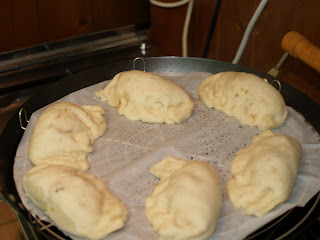
When all that's done, roll the dough out into a log and slice that into chunks. You will need to roll each chunk out into a 9cm diameter circle, so make them the right size for that. As you may have guessed, you must roll them out. Then place a heaped spoonfull of the meaty mixture on each circle of dough, fold the dough over and pinch the edges together to seal - just like Cornish pasties, really.
Except that these ones get steamed. I do that in the wok: I have a big one, with a big domed lid, and a cake tray which just fits in; it works for me. About ten minutes steaming per batch should do the trick. When you want to eat them just stick them in the microwave to reheat and serve with the dipping sauce(s) of your choice (sweet chili sauce is a must around here, but garlic/vinegar or whatever else takes your fancy is good). The little buggers freeze really well too, so freeze any leftovers for one of those days when you really can't be arsed cooking.
At around this time I managed to get my laptop back to the land of the living, after replacing a couple of files (thank god for Linux distros on a bootable USB key) so it was time to think of dessert for Sophie. And as we had three or four ripe pears lurking in the fridge that wasn't too difficult - a pastis aux poires.
In this case, pastis has nowt to do with the quintessential (and absolutely disgusting, as far as I'm concerned) provençal alcohol flavoured with aniseed: it is in fact a corruption of pastilla, which is an Algerian/Moroccan pie made with meat (often pigeon), sugar, almonds, spices and godnose what else.
I found it on Clotilde Dussolier's excellent Chocolate & Zuchini blog yonks back, and it's become a favourite. You need to start, fairly obviously, with some pears. About four would be good. Peel them, core them, and cut them into cubes, then fry them very gently in butter until they're smelling of pear heaven. At which point you should add a good handful of raisins, 1 tbsp of sugar, maybe some cinnamon, a dash of the poison of your choice and, if it looks dry (which it shouldn't) a bit of water, then cover and let simmer for 10 minutes.
During which time you can get the pastry ready. This is just the bog-standard phyllo you've come to know (and, I hope, love) - brush a sheet of phyllo with melted butter, sprinkle with cinnamon sugar, line pie dish with it - then repeat two or three times. Old history.
Scoop the pears and raisins out of their juice and into the pie dish, fold the floppy pastry edges over the top and brush them with melted butter as well while the pear juices reduce like mad over a really hot flame. When all that's nicely syrupy dribble it over the tart and bung it in the oven for twenty minutes or so.

This is nice the next day if you happen to have any leftovers, but you really do need to give it 5 minutes or so in the oven. Otherwise the pastry is all soggy, which is not so good. But at least my computer is good to go, so I'm fine for Paris.
And, in case you're interested, the birthday party was really good. First time in years I've seen Sophie in a dress. Got elegantly wasted, as usual, but at least it was with a 98 Burgundy that I'd had lurking in the cellar for years. And those Frog-persons really do have natural rhythm when it comes to dancing.
Which means that before I go up to Paris on Sunday I have to get my laptop working again, and get food ready for Jerry and Rémi, who happens to be Sophie's youngest and who's spending the night at our place. Rather atypically from a Frog-person, he quite likes exotic cuisine, and it fact it was he who asked for what our kids used to call (back in the days before they'd completely mastered the art of the consonant) "steamed pork bums".
Which are not as rude as they may sound. What you need is about 400gm of left-over barbecued pork (or a mix of pork and beef is nice), finely minced. Personally, every time I barbecue a bit of rouelle de jambon (which is just a 2 or 3-inch thick slice from the poor animal's leg) there's always heaps left over (unless of course we've got a pile of friends around) so I just cut the meat off the bone, chop it into chunks and stick them in the good old Kitchen Whiz, then stick the resulting mince into the freezer until I need it.
Once that's thawed out you need to make the sauce. Peel and finely chop a good chunk of ginger, ditto a clove or two of garlic, and fry them up gently in a little oil for a minute. Then add, in no particular order, 2 tbsp hoi sin sauce, 2 tbsp oyster sauce, 2 tbsp soy sauce, 1 tbsp sesame oil and, if you're that way inclined, a dose of hot chili sauce. Let that cook for a little, then add 3 tsp cornflour mixed up in a little water, bring to the boil and let it get good and thick. At which point take it off the heat, stir in the mince well so it's all nicely mixed, and let it cool.
So now it's time to make the dough. You can buy special bun flour from most Asian grocers, or you can use standard flour, or I like a half and half mix of normal flour and rice flour, which gives a lovely silky texture but, due to the lack of gluten (or something) makes a very fragile dough. Be warned. Whatever. You'll need two cups of that, about 70 gms of pork dripping and 1 tbsp of sugar - stick the lot in the whizzer and give it a good pulse to mix in the dripping.
You've two options at this point: use baking powder or yeast. If you're using baking powder, put a teaspoon in with the flour and add a tbsp of vinegar to the water; if yeast, it's be a good time to mix up a sachet of instant yeast with about 100ml of warm water and a bit of sugar to let it froth. I use yeast, myself, but it's up to you.
Whichever you prefer, put the food processor onto slooow and add the yeasty mixture (or vinegar/water): you will definitely need to add more than the 100ml but do it slowly, especially if you've used rice flour, as the line between dry and sloppy is a fine one. Once you've got a soft (but not too soft) dough, set it aside and let it rise. Which'll take about an hour. I used that time to do a few quick searches and recreate my BOOT.INI file, which at least got me to the point where my laptop was booting (and then hanging). Progress, of a sort. Still hadn't got anything ready for Sophie.
When all that's done, roll the dough out into a log and slice that into chunks. You will need to roll each chunk out into a 9cm diameter circle, so make them the right size for that. As you may have guessed, you must roll them out. Then place a heaped spoonfull of the meaty mixture on each circle of dough, fold the dough over and pinch the edges together to seal - just like Cornish pasties, really.
Except that these ones get steamed. I do that in the wok: I have a big one, with a big domed lid, and a cake tray which just fits in; it works for me. About ten minutes steaming per batch should do the trick. When you want to eat them just stick them in the microwave to reheat and serve with the dipping sauce(s) of your choice (sweet chili sauce is a must around here, but garlic/vinegar or whatever else takes your fancy is good). The little buggers freeze really well too, so freeze any leftovers for one of those days when you really can't be arsed cooking.

At around this time I managed to get my laptop back to the land of the living, after replacing a couple of files (thank god for Linux distros on a bootable USB key) so it was time to think of dessert for Sophie. And as we had three or four ripe pears lurking in the fridge that wasn't too difficult - a pastis aux poires.
In this case, pastis has nowt to do with the quintessential (and absolutely disgusting, as far as I'm concerned) provençal alcohol flavoured with aniseed: it is in fact a corruption of pastilla, which is an Algerian/Moroccan pie made with meat (often pigeon), sugar, almonds, spices and godnose what else.
I found it on Clotilde Dussolier's excellent Chocolate & Zuchini blog yonks back, and it's become a favourite. You need to start, fairly obviously, with some pears. About four would be good. Peel them, core them, and cut them into cubes, then fry them very gently in butter until they're smelling of pear heaven. At which point you should add a good handful of raisins, 1 tbsp of sugar, maybe some cinnamon, a dash of the poison of your choice and, if it looks dry (which it shouldn't) a bit of water, then cover and let simmer for 10 minutes.
During which time you can get the pastry ready. This is just the bog-standard phyllo you've come to know (and, I hope, love) - brush a sheet of phyllo with melted butter, sprinkle with cinnamon sugar, line pie dish with it - then repeat two or three times. Old history.
Scoop the pears and raisins out of their juice and into the pie dish, fold the floppy pastry edges over the top and brush them with melted butter as well while the pear juices reduce like mad over a really hot flame. When all that's nicely syrupy dribble it over the tart and bung it in the oven for twenty minutes or so.

This is nice the next day if you happen to have any leftovers, but you really do need to give it 5 minutes or so in the oven. Otherwise the pastry is all soggy, which is not so good. But at least my computer is good to go, so I'm fine for Paris.
And, in case you're interested, the birthday party was really good. First time in years I've seen Sophie in a dress. Got elegantly wasted, as usual, but at least it was with a 98 Burgundy that I'd had lurking in the cellar for years. And those Frog-persons really do have natural rhythm when it comes to dancing.
Subscribe to:
Posts (Atom)


 Posts


