Saturday, 12 December 2009

Yet another lunch with Sophie ...

Well, Margo was off in Lyon yesterday and today, so after Carrefour (where, with great restraint, I refrained from killing any of the silly old cows who run over your feet with their shopping trolleys) and the market (where I also managed to avoid doing too much damage, despite the presence of people in festive costumes trying to hand out messages of good cheer to all and sundry) I headed off to Sophie's, where we started off the day with a seriously good Bordeaux, looking out at the wannabe snow that was plooshing sullenly from the clouds about three meters above our heads.

Bloody miserable weather, in fact: cold, grey, damp and dismal. Sort of thing that makes me want to eat a good boeuf bourguignon or fluffy pork croquettes in gravy - unfortunately these are things that you really need to do ahead of time, and it's been fine and sunny all week. Until now, of course. So all I had about my person was a couple of slices of fillet and some veal chops.

Now Sophie's always protested that she doesn't really like red meat: in fact, what she doesn't like is raw red meat. Which means that she's oblivious to the delights of a rare steak, which is rather sad really. On the other hand, she is a Bressane, which means that she's accustomed to vast quantities of cream, so it was a bit of a no-brainer: I decided that the obvious thing to do was re-offend with filet de boeuf Woronoff where, as I've told you before in rather more detail, the meat gets poached in cream. (And other things, but that's beside the point.)

So that was lunch for the adults decided on, now just needed to decide on something for the two walking midden pits (or adolescents, as some call them). Having veal chops, cream and an apple to hand, the answer was pretty clear: côtes de veau Normande.

This is another of those appallingly simple recipes that really don't deserve the name, which is rather embarrassing but here goes anyway.

First of all, turn the oven on. You'll need it for the meat, and you might as well peel some potatoes, cut them into chunks and roll them around in hot oil before sticking them in to roast. If, that is, you prefer that to the more traditional (read "boring") accompaniment of rice or plain noodles. Whatever. Now, get out your trusty frying pan and heat it up: stick in a good chunk of butter and when that's sizzling, brown the veal chops on both sides.

I would strongly suggest that you not use a non-stick pan for this. Nice as they are, they do have one major defect: nothing sticks to them, so there'll be no caramelised sucs (brown crispy bits, if you prefer) to be incorporated into the sauce. Which would be a shame.

When the chops are nicely golden, slosh some calva over and flambé them. Calvados, incidentally, is the Norman apple brandy: if you can't get that ordinary cognac will do, or scotch if you prefer. In any case, and whatever your taste in alcohol, once that's done you should remove the chops from the pan and put them in a baking dish just large enough to hold them comfortably. Then pour about 20 cl of cream into the pan and bring it to a simmer, scraping up all the brown crispy bits with a spatula so that they dissolve. The cream should start to thicken a bit, so slosh in another shot-glass of calva, stir it well and then pour the whole lot over the chops. Cover the dish with tinfoil and bung it in the oven: it'll be ready in about 30 minutes.

Now give the pan to an adolescent, along with a chunk of bread: this will clean it, ready for the next step. Which is where you core and peel an apple (Granny Smith or something similar) and cut it into 5mm slices. Then get some more butter bubbling in the pan and fry the apple slices until they too go golden, at which point you should sprinkle them with sugar on both sides and carry on cooking gently until that caramelises.

When that's done - hopefully about 5 minutes before you plan on eating - remove the chops from the oven and stick a couple of apple slices on each one. Notice how the cream sauce has thickened nicely? Anyway, put the foil back on top and put the whole lot back in the oven (which you can probably turn off now) until you're ready to go. And just before you serve it, it would be a good idea to sprinkle it with heaps of chopped parsley.

Between the beef and the veal we had serious amounts of cream sauce, not that I need have worried. It's rare to see the stuff disappear so quickly, even with the help of a couple of baguettes. And Sophie swore she loved the meat, and for a fact she wasn't sharing with anyone.

And for dessert? Can't do better than a tarte tatin, can you? Especially if you have some cream left over to go with it.


Friday, 11 December 2009

Frying Fun


Tonight is the start of Hanukkah, and one continent + one ocean away, my friend Karen is frying latkes already, because it is evening over where she is (the nether regions of hell), and her original plans of verdure in pastella were scuttled by an absence of decent produce on a December morning in Frangy. I had my fried veggies last night in the mixed tempura at our local izakaya (okay, with a couple of bits of treyf as tasty add-ons), in anticipation of this greasiest of culinary holidays, the festival of fried foods.

Hanukkah eats rival the faire of county fairs in the U.S. in terms of oil-soaked deliciousness. Sufganyiot, bumuelos, and latkes fit right in alongside things like funnel cake and deep-fried avocados. There is some sort of significance of oil in the origins of the holiday, but nowadays it's really just about the frying. Here are a couple of faves from my house.


Wonton. This is crazy good stuff and incredibly easy. Pick up some skins at any market carrying asian stuff, and make ravioloni with pretty much whatever filling you want—anything you pick will taste pretty good inside a fried wonton skin. (I used a filling that was based on ground pork. No, not too kosher.)

Poofy chips. These start out like smallish, plastic-y discs or rectangles of mostly dehydrated rice paste, but when they hit the oil, they curl up and then unfurl into enormous, feather-light crisps of crunchy fried air. Eaten immediately after frying, the moisture content is so low that they crackle when they hit the moisture of the tongue. I've got shrimp-flavored and tempeh-blended ones in the pics.


So whip out the gallon jugs of oil. Now. 'Tis the season to be frying!

Latkas - potato pancakes

Happy Hanukkah!
For those who may not already know this, Hanukkah is an 8 day festival of feasting. Tonight is the first night, and a Sabbath, and I've got my stepdaughters, so obviously I'm making latkas. Every year we have a latkafest: tons of latkas, served with sour cream & homemade apple sauce, accompanied by a green salad.
Latkas are simple to make, although there is a certain art to it. Some people like them soft, some crispy in consistency. Others like them mashed or shredded in texture. Plain or with onions & herbs? Mine are crispy, shredded, chocked with onion & sprinkled with herbs.

Tips: As I write, I'm frying up the latkas, since I actually want to spend time with the family, not in the kitchen frying at the last minute. They can be made ahead of time, then reheated in an oven, even refrigerated or frozen.
Use the following as a guideline. Much depends on the starchyness of the potatoes, so add flour as necessary. For a main course for 6 people I use about 3 lbs of potatoes.

Latkas
1 lb potatoes
1 onion
1 egg
2 tbs flour
1/2 tsp baking powder
salt & pepper
pinch nutmeg
herbs to taste: parsely, rosemary, thyme, sage...
oil for frying

Shred potatoes. Press into a colander, squeezing out as much water as possible (I do it by hand).
Add thinly sliced onion and all the rest of the ingredients.
Let sit while heating oil in a large pan.
With a slotted spoon, scoop out mixture, trying to drain any excess liquid (this is inevitable: if too liquid, add some flour, but not so much to make the latkas crunchy). Oil should be hot!
Place in oil, pressing gently (remember hot oil tends to bubble!) on the mixture. When edges brown, turn over with the aid of two utensils.
Place fried latkas on a dish lined with paper towels or brown bags to absorb excess oil.
Serve with condiments.

To reheat, place on a cookie sheet in warm oven.

Saturday, 5 December 2009

French-style Chinese rubber chicken ...

Well, this is one I haven't done for a long time. Don't even know why it popped into my head this morning after all these years, if it wasn't that all the chickens I could see as I prowled around Carrefour seemed to be rubber ones.

And what the hell was I doing roaming in a hypermarket in the lead-up to Christmas? A bloody good question, which I shall ignore. Well, actually, not. The parent-teacher meeting at Jeremy's lycée took all morning (and despite arriving on time I still didn't get to meet a single one of his teachers) so I missed the market and was consequently obliged to buy things elsewhere. Which gave me no pleasure, but there you are. The things we do for our kids.

Anyway, I didn't want turkey, nor goose, nor duck, and the only alternative seemed to be these flaccid-looking corpses that seemed vaguely related to chickens, doubtless forking off the family tree a few million years ago - whatever, the sight triggered one of the few remaining neurons in the back left of what we shall charitably call my brain, which duly obliged by bringing forth the memory of what follows. Which is not, let it be said, too foul - and if all you happen to have is, in fact, rubber chicken, it will at least be edible.

I am assuming that you have a large, sharp knife; you will want this to cut the birdbeast up. Like, take the legs off and then cut them in two at the joint, remove the wings with a decent bit of breast meat still attached, then slice the carcasse in two horizontally (giving you back and breast), fling out the back (or turn it into stock if that turns you on) and cut the breast into four chunks.

So far so good, and now would be a good time to get the marinade ready. Luckily this is not difficult, involving as it does no more than mixing together 1 tsp cornflour, 4 tbsp lemon juice, 4 tbsp soy sauce, 1 tbsp honey, and as much garlic, ginger, five-spice powder and Tabasco sauce as you feel up to. Pour all that over the chicken pieces (which I hope for your sake are in a bowl and not still sitting on the chopping board) and set aside for half an hour or so.

During which you're pretty much on your own. Personally, I went down to the garden and poured a bit of diesel down the chimney pipes from the woodburner in the kitchen and set fire to it: not only is it fun (flames everywhere!) but it doubtless contributes to global warming (I would like to actually see some of that, please), increases my carbon footprint, and burns off the accumulated tar which would otherwise cause a chimney fire. Which you don't want, believe me.

Whatever you get up to, and quite frankly I don't want to know, once done it's time to get the meat in the oven. But just before you do that, get some vegetables ready. Some leeks, sliced thinly, would be good, as would be sliced brussels sprouts with scallion and red pepper. Add some broccoli flowerets, why not? And bring out a tin of bean sprouts from the pantry.

This is going to be cooked en papillotte - in this case, in paper. So you're going to need a large plate, and enough grease-proof paper to enclose the chicken bits. After which it's simple enough. Put the paper on the plate and put the chicken pieces on top. Spread the vegetables over and pour the marinade on top, then flip the other half of the paper over to cover, fold the edges over to seal (don't be ashamed to use a stapler. I do) and stick it the oven for an hour.

Despite having started off with something with no flavour and the texture of a six-month's dead otter, the end-result is more or less guaranteed to be delicious. Tender, subtly-spiced, and a vague taste of something that brings chicken to mind. Plain steamed rice with it is perfect, why try to complicate things?

Sunday, 29 November 2009

CACIUCCO ALLA LOMBARDA


This started out as a caciucco alla livornese, a hearty fish stew from Livorno, but then I realized that I've never actually eaten caciucco or even been to Livorno, though I had a pretty good idea of what I wanted this stew to taste like. I have had triglie alla livornese—red mullet stewed in a tomato base—which I liked a lot, and my very Swiss-Milanese grandmother-in-law noted to me that while the triglie were good, the little bony dudes were a lot of work, and the caciucco was something that she liked a lot more. She was not known for liking to work very hard for anything.

So although Adri is a hard worker, she somehow inherited Nonna Elsa's appreciation for boneless seafood, and although I actually doubt that any real caciucco has ever been so carefully relieved of bones, this is the way it would need to be for tonight's meal. Oh, and Adri really likes clams, too, so I'm buying some of them as well. [Weather and tides won't let me go looking for wild ones today.]

The impetus for this little idea was a brace of scorfani (scorpionfish) that I brought home from a wintertime fishing trip. Lo scorfano basically cries out "make soup," and it isn't just me who thinks this. There's no ingredient more indispensible for any European-style fish stew (from zuppa di pesce to bouillabaisse) than some kind of scorpionfish or poisson rouge. The flesh is excellent on its own, but the stock made from the bones and head is simply the very best fish stock possible.

I began by gutting and thoroughly rinsing the three scorfani (plus one treefish—a bonus catch), from which I then cut completely boneless fillets. Clean heads, bones, and skin went into a pot and the fillets into the fridge. To the fish in the pot, I added cold water, salt, a handful of slightly smooshed garlic cloves, and put this on gentle heat to simmer for about an hour. After that, I strained out the stock through a colander, and then through a fine-mesh strainer.

This fish base is enriched with a tomato mixture, which started as a sofrito (I use the Spanish spelling of this word, just to frustrate my spouse) of olive oil, onions, garlic and a small potato that's been diced, to which I added a box of diced tomatoes and let reduce for a bit, then added it to the fish stock and then blended things somewhat with my new wand-type blender. Tasted it—rich but a bit tame, so I added a teaspoon of a paste made from peperoncini from Calabria—this is basically a sambal oelek with an Italian and not Asian flavor. At this point I've got a red stew base that is rich in flavor and somewhat thickened by the potatoes in the sofrito. But more potatoes are needed for the stew, so a couple more are cut into bite-sized chunks and simmered in the pot for a few minutes.

While the second round of potatoes are cooking, I wrestled with the clams. I got littlenecks, which are pretty large clams, and my plan was to open them and put them in at the last minute with the fish. But damned, these things were clammed shut, and I couldn't get my knife in between the valves. Only one thing to do—cook them until the adductor muscles detached from one of the shells and the clams started to open. This added time to the prep, but this is still better than having the clams with their massive shells in the caciucco. Anyways, once I got the clams out of their shells and added them and the scorfano fillets to the stew, the potatoes were very tender.

After about four minutes (the time it took to set the table and call in the spouse for dinner) the soup was ready.

Saturday, 28 November 2009

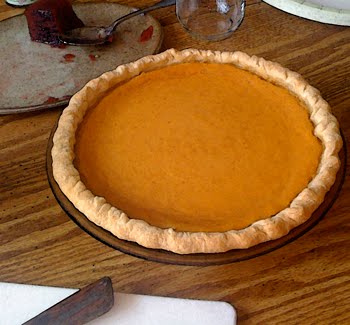
What kind of pie?


Corn on the cob and sweet potatoes—two foods that most European-types I know don't love (my spouse is an exception). My father-in-law calls both "pig fodder," but then again he will eat polenta no prob, but then again he is from Milan so I guess eating swine chow is okay if it's dried and milled. I'm also pretty sure that it's dried corn that they pump through the feeding tubes (calorie-bongs?) used in fattening waterfowl livers for foie gras, and so the French are consumers of lots of corn as well, if somewhat less directly than the Milanese. But fresh sweet corn is a wonderful thing, and if the Europeans aren't eating it, then fine—there's more for us. This is exactly what Karen said when I told her that a post on sweet potato pie would not be of much interest to her yankee-expat followers who are cooking for European spouses and their families.

As far as flavor is concerned, I don't think it really matters which variety of sweet potato gets used, but the kind that is bright orange is the classic. A sweet potato pie made from a white- or yellow- flesh variety would look pretty non-traditional. Since these potatoes come in some pretty irregular shapes (usually very thick in the middle, tapering to narrow ends), I start by cutting them into uniform sized pieces that will cook in the same amount of time. I drop them into boiling, salted water and simmer them until they're done—about 15 minutes, depending on how big the pieces are. Then I drain them in a colander, and while they're hot, I remove the skins and run them through a potato ricer. This will leave a small amount of fiber-y stuff in the mash, which I prefer to eliminate by running it through a food mill (this can be done after the mash has cooled).

A classic American pie crust is your basic short crust with the difference that the butter is not quite fully incorporated into the flour. The tiny chunks of butter flatten out between the flattened bits of dough, and this is what makes a flaky (rather than crumbly) crust. I make mine with about two sticks of cold butter (roughly 400 grams, salted of course) which I cut into a good measure of flour (three cups? Sounds about right.) with a pastry knife (which is really a sort of round-bottom potato masher) until the butter is almost but not quite fully blended with the flour. Then I mix in some really cold water (about a quarter-cup) with a wooden spoon just until the moisture is uniformly distributed and the dough actually resembles a dough. Then I wrap the dough in plastic and throw it in the fridge for a couple of hours. Then I roll out a huge circle of dough—there's much more than what's needed for one pie, so I cut off all but a generous inch of overhang after putting it in the pie tin. The rest can go back in the fridge for some other creation. The overhang gets rolled and crimped and I prick the bottom a few times with a fork. Then this gets covered with plastic again and thrown in the fridge. I know that this sounds pretty complicated and pie crusts can be pretty intimidating at first, but you just have to make it a few times and then it's not such a big deal.

My pie filling is a can of sweetened condensed milk (I think the standard size in the U.S. is about 7 or 8 ounces), three eggs, a bit of ground ginger (the dried stuff, not the fresh stuff), a bit of nutmeg, and about two cups of the cooled sweet potato mash. After homogenizing all this you'll need to add sugar—how much is needed will depend on how sweet the potatoes were (and there's quite a lot of variation in sugar content) and how sweet you like your pie. I like using superfine (baker's) sugar for this, but I suppose regular granulated would work, too. Need a rough estimate for starters? Maybe about half a cup. I typically add a bit more sugar than what tastes right when I'm making the filling, since I find that the final product usually ends up not sweet enough when I add sugar just to taste.

The filling should now be thick but pourable. Remove the crust from the fridge, fill and bake at 350°F (175°C) for about 45 minutes to an hour until the crust is golden and the filling is puffing up but not quite browning. If you have extra filling, I suggest filling a couple of ramekins and baking them along with the pie—this makes a nice pudding—but the cooking time may be a little different from the pie.

This is a pie that should be thoroughly cooled before serving (otherwise the spices you added may be overpowering), so making this pie the day before the big dinner is both wise and gets one more dessert out of the way.

Thursday, 26 November 2009

Cream puffs

Those of you who grew up with me (yes, that includes grad school friends, let's face it) will probably remember the killer cream puffs. So here's the recipe (happy now, you who shall remain nameless????!!!!):

1 stick of butter (real butter, no substitutes!)
1 cup water
1 cup flour
Pinch of salt
4 eggs

Tips:
1. It's essential to use precise measurements & follow directions scrupulously or these will be cement puffs
2. DO NOT OPEN THE OVEN THE 1ST 20 MINUTES OR THE PASTRY WILL NOT PUFF

Preheat oven to a high-medium heat.
Melt butter in water. DO NOT BOIL.
Take pot off heat, add the flour with salt ALL AT ONCE. With wooden spoon quickly mix & form into a ball.
Let mixture cool 10 minutes.
Beat in eggs ONE AT A TIME.
Spoon onto a cookie sheet, leaving an inch between.
Place in oven. DO NOT OPEN DOOR!
After 20 minutes, turn heat down to medium.
When pastry is golden remove from oven and place puffs on a cooling rack.
If hermetically sealed, the puffs will keep up to 5 days.

Fillings: whipped cream, custard, ice cream.....
Glaze: sugar, caramel, chocolate.....